Closing the CTV Yield Gap
Introduction
When Viant acquired TVision — an attention measurement company built around second-by-second, eyes-on-screen signals for CTV — it sent a message about what the buy side now cares about most: not just access to CTV inventory, but the quality of the data attached to it. Publicis Groupe’s agreement to acquire LiveRamp for $2.2 billion points in the same direction. A holding company spending that kind of money on a data collaboration platform isn’t making a bet on reach; it’s making a bet on signal quality and identity infrastructure. Programmatic CTV is maturing fast, and buyers are getting more selective about where and how they spend.
That selectivity is coming with real money behind it. According to Premion’s 2026 CTV/OTT Advertiser Survey, 70% of advertisers plan to increase CTV spending this year by an average of 17% — part of a market on track to hit $46 billion by 2028, with half of all CTV/OTT advertising expected to be purchased programmatically. The infrastructure question — who controls those auctions, and how well — has never mattered more.
Approximately what share of your CTV ad revenue is currently transacted programmatically?
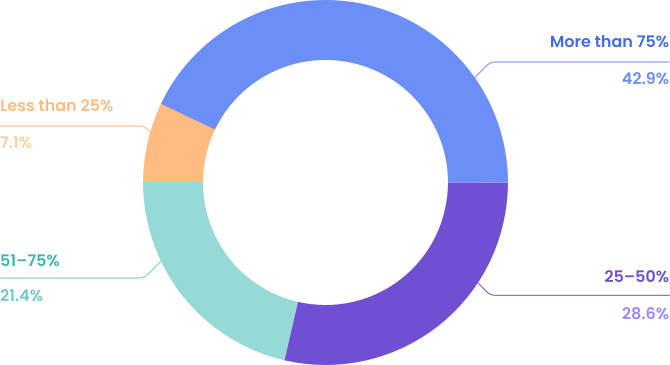
Source: EX.CO targeted CTV media owner survey, May 2026

Talk to the people running monetization at FAST channels, AVOD platforms, and broadcaster streaming properties, and a different picture emerges. Audience is growing, but revenue isn’t keeping pace. Fill rates shift without a clear cause. CPMs stay flat or soften, even when market reports show spend is rising. The reporting doesn’t explain it, which makes it harder to fix — and easier to assume the problem is on the demand side, when it usually isn’t.
The pressure doesn’t stay at the operational level. It surfaces in board conversations about yield per viewing hour, in uncomfortable comparisons to what linear inventory used to generate, and in leadership questions about whether programmatic CTV is worth the complexity it adds. For most revenue leads, the hardest part isn’t identifying that something is wrong — it’s having a clear enough picture of where the problem lives to make the case for fixing it.
What best describes your primary CTV inventory type?
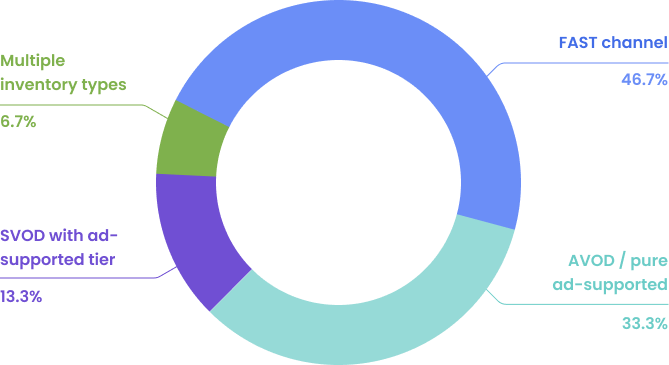
Source: EX.CO targeted CTV media owner survey, May 2026
In a recent EX.CO survey of CTV media owners, nearly 80% said they believe their current setup is leaving revenue on the table. That’s not a perception problem — it’s structural. The distance between what CTV inventory is worth and what media owners are actually realizing has a name: the yield gap.
Do you believe your current CTV monetization setup is leaving revenue on the table?
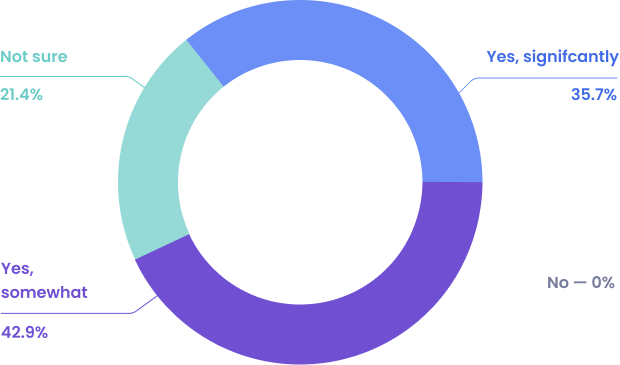
Source: EX.CO targeted CTV media owner survey, May 2026
It exists because the programmatic infrastructure most media owners rely on wasn’t built for CTV. It was retrofitted from display — designed for banner auctions, not ad pods; for single impressions, not sequential slot decisioning; for a world where signal loss was an inconvenience, not a CPM problem. New SSP integrations got layered on top. Partner counts grew. But the underlying auction architecture didn’t change, and neither did the visibility into what’s actually happening at the impression level.
This guide is for the teams responsible for closing that gap: CTV media owners managing real programmatic complexity without the engineering bench that the major streamers can throw at it. The core argument is simple: the yield gap is a technology problem, not a partnership problem. Which means it’s solvable.
Fragmentation created more paths — not more revenue
For years, the default playbook for growing CTV revenue was simple: add more demand partners. More SSPs, more integrations, more auction participants — the logic being that more bidders means more competition, and more competition means higher CPMs. It made intuitive sense. It hasn’t worked.
Over the past 12 months, how has your CTV revenue performance changed?
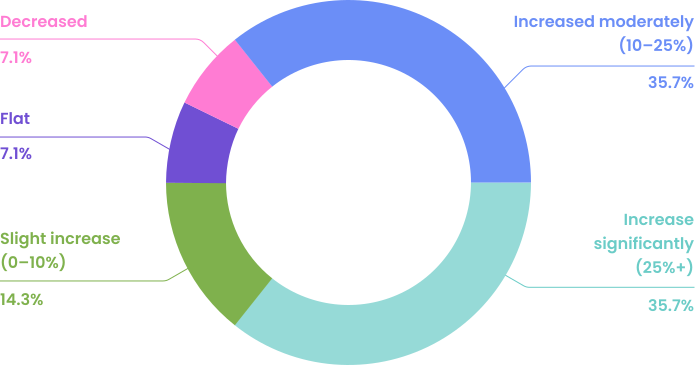
Source: EX.CO targeted CTV media owner survey, May 2026
According to Jounce Media, the average CTV platform now authorizes around 30 SSPs to sell its inventory — roughly double the number from a year ago. But more partners have produced more reselling, not more revenue. When inventory passes through a reseller rather than a direct integration, the economics shift: direct platform auctions clear at a median CPM floor of $14, while reseller auctions sit at $19.50. That’s a 39% premium, inflating what buyers pay without flowing back to the publisher who owns the inventory.

Buyers have noticed. Facing inflated reseller costs, major DSPs and agencies are now actively consolidating spend onto more direct, low-reseller paths. Jounce’s data shows that in 2025, these durable supply chains represented 64% of all RTB bid requests and captured 69% of all DSP gross ad spend. The more SSP integrations a publisher adds, the more they look like the kind of noisy, over-intermediated supply that SPO-focused buyers are trying to avoid.
The media owners in our own survey said it plainly. One cited “hops in the chain” as their single biggest revenue limiter. Another identified “fixing the piping to relay the correct contextual and metadata” as the change that drove their biggest revenue improvement. They’re not describing a demand problem. They’re describing a plumbing problem.
That problem falls hardest on mid-tier media owners. Large streamers have the leverage to negotiate direct integrations, set contractual terms with SSP partners, and dedicate engineering resources to managing supply path quality. Mid-tier operators inherit the same fragmented infrastructure — and manage it with a fraction of the support.
What is currently the biggest limiter of revenue growth in your CTV monetization strategy?
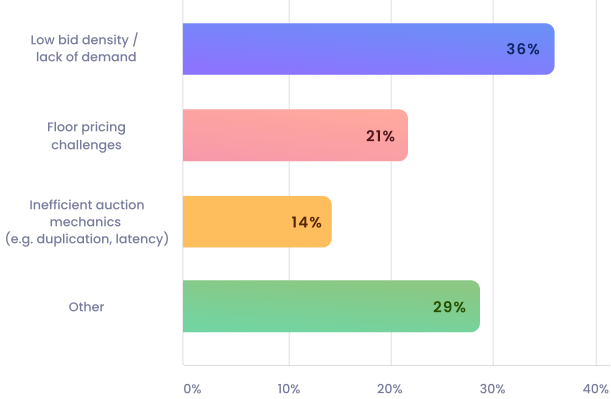
Source: EX.CO targeted CTV media owner survey, May 2026
Three hidden revenue leaks every CTV media owner should know
Most of the yield gap doesn’t show up in standard reporting. It happens upstream of the dashboards, in the parts of the auction process that aren’t visible in aggregate CPM or fill rate. Three structural leaks account for most of it — and they tend to compound each other.
Leak 1
Signal degradation
Demand partners bid on what they can see. In CTV, the most valuable signals — content genre, IAB category, audience data, ad slot position within a pod, device, and app context — often don’t pass cleanly through the supply chain. Every hop between media owner and buyer is an opportunity for that data to be stripped or dropped. When buyers can’t see what they’re bidding on, they bid less, and premium inventory clears at commodity prices.
This was the most-cited issue in our survey. One respondent named “lack of trusted livestream signal and OMID values not passing to DSPs” as their single biggest revenue limiter. Not one respondent described themselves as “very confident” that their setup was maximizing the value of available signals. The revenue consequence is measurable: industry data from major SSPs and bidstream analytics vendors shows that publishers who pass a complete content object see CPM lifts of 27-40% and up to a 7x increase in bid rate. The gap between clean and incomplete signal isn’t marginal, it’s structural.
How confident are you that your setup maximizes available bidstream signals?
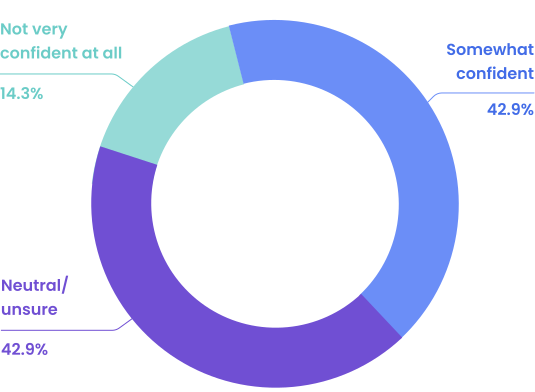
Source: EX.CO targeted CTV media owner survey, May 2026
Leak 2
Static floor pricing

Most CTV media owners set price floors manually — a configuration decision revisited quarterly, or monthly at best. The problem is that CTV inventory value changes constantly: by daypart, content type, device, auction volume, and what buyers are spending in real time. A floor set in January will leave money on the table in March when demand spikes, and suppress fill rate in a softer week when buyers pull back.
The right floor price isn’t a static number; it’s a continuously updated prediction. Floor pricing was among the most-cited revenue limiters in our survey, flagged across FAST, SVOD, and AVOD inventory types alike. The friction isn’t that media owners don’t know their floors need attention. It’s that managing floors well at the impression level is a problem manual configuration was never designed to solve.
This is particularly acute for FAST channel operators. FAST inventory carries its own CPM dynamics — genre and daypart variance is wider, platform operators like Roku and Samsung take a revenue share off the top, and ad load constraints mean every unfilled or underpriced impression carries more weight than it would in a longer-form AVOD environment. A floor pricing strategy built for AVOD will systematically underperform on FAST, and most default configurations don’t account for the difference.
Leak 3
Auction architecture mismatch
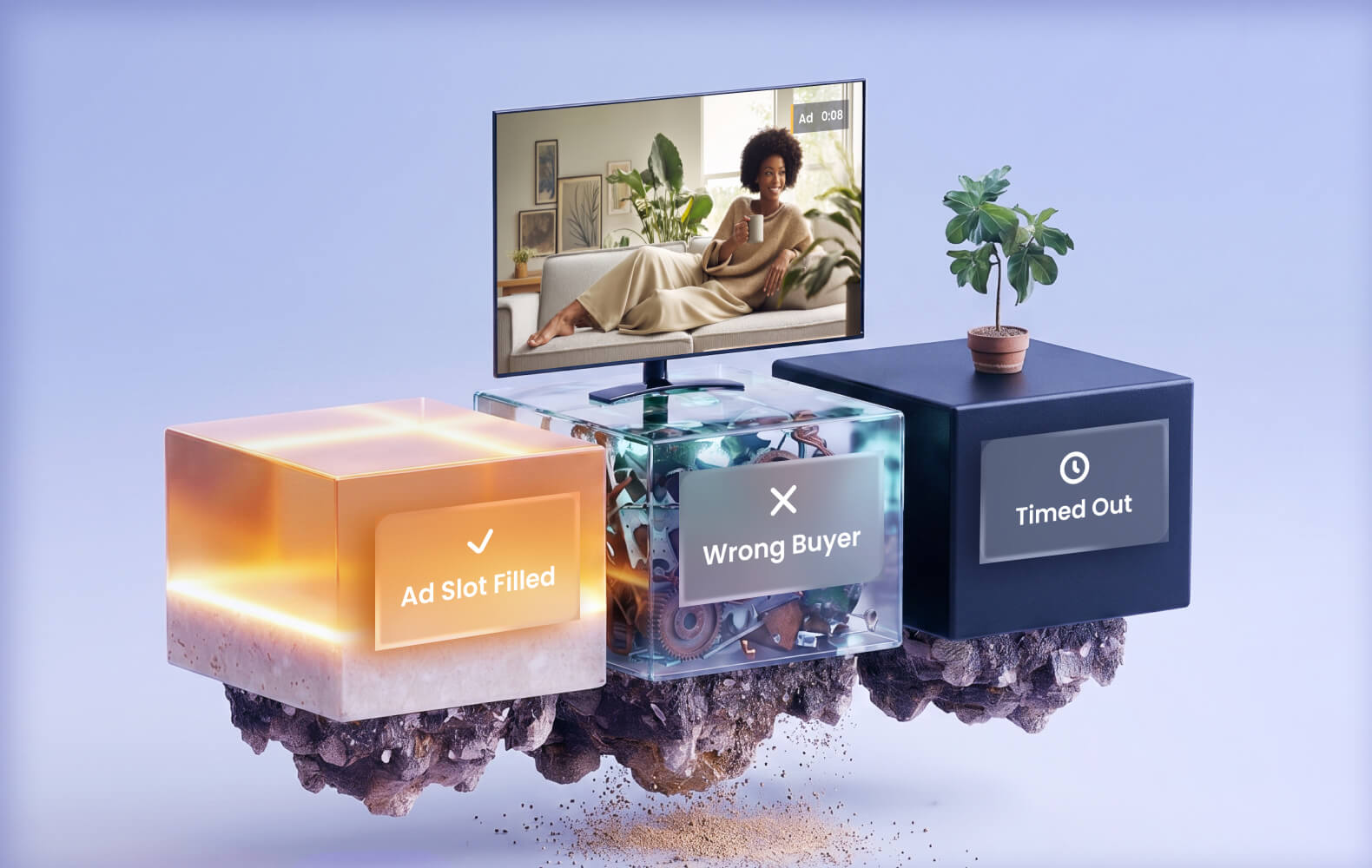
The programmatic stack most CTV media owners rely on was built for display and web, then adapted for the big screen. The adaptation is imperfect in ways that cost real revenue. Unlike display, CTV brings a distinct set of auction demands:

Ad pod sequential decisioning
The best buyer for slot 1 isn’t necessarily the best buyer for slot 3. Frequency caps, category exclusions, and competitive separation all interact across the break — and a display-era auction engine evaluates each slot in isolation rather than optimizing the pod as a unit.

Tighter latency budgets
A CTV ad break has a fixed window. Any auction that doesn’t resolve within it doesn’t fill.

Session-level dynamics
A viewer might watch for 90 minutes across multiple pods in a single session. Optimizing impression-by-impression ignores session-level value that smarter decisioning could capture.
Inefficient auction mechanics were a recurring barrier cited in our survey — and the most insidious of the three leaks, because the symptoms look like demand problems. Lower CPMs, partial fill, and occasional timeouts: all of it points toward “not enough buyers,” when the real issue is that the architecture isn’t giving buyers a clean signal to bid on.
What your SSPs are — and aren’t — responsible for
Inefficient auction mechanics were a recurring barrier cited in our survey — and the most insidious of the three leaks, because the symptoms look like demand problems. Lower CPMs, partial fill, and occasional timeouts: all of it points toward “not enough buyers,” when the real issue is that the architecture isn’t giving buyers a clean signal to bid on.
| What SSPs Do Well | What SSPs Typically Don’t Do |
|---|---|
 Provide access to demand
|
 Continuously reoptimize auction controls
|
|
Report on what cleared
|
Manage signal quality from your content systems
|
|
Offer auction controls (e.g. floors, deal IDs, blocklists, basic rules) |
Make impression-level decisions about which demand path is best for each auction
|
Adding SSP partners gives a media owner more access to demand. It doesn’t give them better decisioning about which partner should win which impression, or why. And increasingly, buyers running SPO are making that distinction themselves — pruning the supply paths they use, consolidating spend toward the cleanest, most direct routes to inventory. A media owner with 12 SSP connections and no optimization layer above them looks noisier to those buyers than one with five clean connections and consistent signal hygiene.
Our survey reflects how widely this is felt. Roughly half of respondents described themselves as actively testing or optimizing new setups — which suggests an awareness that the current approach isn’t working as well as it should. But testing without a decisioning layer above the SSPs produces experiments the infrastructure can’t fully act on. You can see that one setup outperforms another without being able to systematically capture why, or replicate it at the impression level where the revenue actually lives.
Which best describes your current approach to CTV monetization infrastructure?
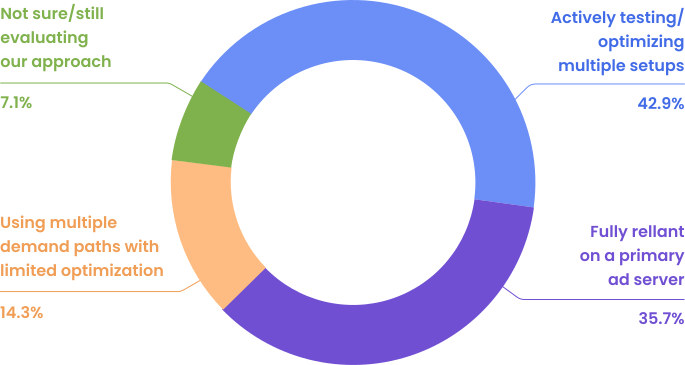
Source: EX.CO targeted CTV media owner survey, May 2026
Where are you prioritizing investment to drive CTV revenue growth over the next 12 months? (Select up to 2)
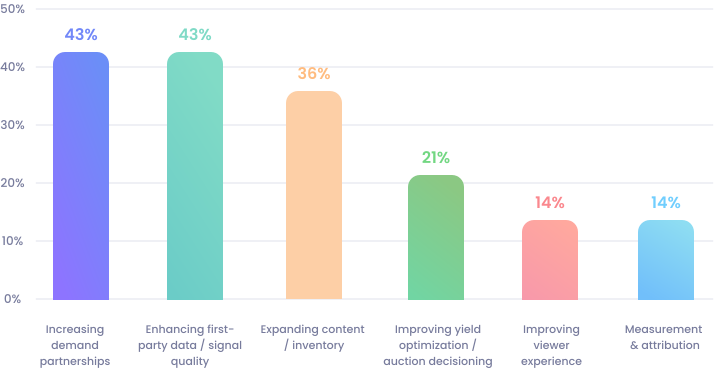
Source: EX.CO targeted CTV media owner survey, May 2026
What a strategic SSP relationship looks like
A default SSP integration and a strategic one look different in practice. The latter should give you:

Granular reporting beyond aggregate
Fill rate and CPM broken down by buyer, content category, device, and daypart — not just a blended number that hides where performance is actually coming from.daypart.

Honest deduplication practices
Specifics on how bidstream duplication is handled, not a general acknowledgment that it’s an industry challenge.

Signal feedback
Clear guidance on which signals are improving CPM performance, and flags when they’re arriving incomplete or being dropped downstream.

Resale transparency
You should know who the downstream partners are, what fees apply, and what the net yield difference is between your direct integrations and resold paths.
Even with the strongest SSP relationships in place, there’s a layer of decisioning no SSP is positioned to provide: cross-SSP, impression-level optimization that works in your interest rather than theirs. That’s the gap the next section addresses.
What smarter programmatic actually looks like
You don’t need a dedicated yield team—or a total infrastructure overhaul—to improve CTV auction decisioning. You can add a layer of intelligence — one that continuously evaluates signals, conditions, and outcomes at a speed and granularity that manual configuration can’t match.
Dynamic floor pricing at impression level
ML-driven yield engines evaluate each auction request individually, predicting the optimal floor based on demand signals, historical performance, time of day, content context, and live market conditions. The floor moves with the market — producing more revenue on high-value impressions, and better fill on those a static floor would have priced out of the auction entirely.
1
Demand path selection and routing
Not every impression should go to every SSP. Some paths perform consistently better for certain content types or audience segments; some are faster, cleaner, or more competitive for a given buyer set. For media owners managing multiple SSP connections, ML models can predict which demand path is most likely to produce the best outcome for a given auction — and route accordingly, rather than broadcasting the same impression across every available pipe.
2
Signal quality management
Signal completeness drifts as integrations update and new ad units come online. A well-built ad server treats signal monitoring as a real-time function: flagging degradation as it happens, catching dropped content objects before they become a CPM problem, and surfacing the link between signal completeness and auction performance so the fix can be prioritized.
3
Pod-level optimization for CTV
In a CTV ad pod, decisions about slot 1 affect what’s available for slot 3. Frequency caps, category exclusions, and competitive separation all interact across the break. Display-era auction logic optimizes each placement in isolation, while CTV-native auction architecture evaluates pods as units — filling each slot with the best available buyer given what’s already been placed, which produces better outcomes across the break, not just at the top of it.
4
The agility advantage
The biggest streamers have built sophisticated yield infrastructure over years — along with legacy contracts, entrenched integrations, and engineering roadmaps that make rapid change difficult. Most CTV media owners have a different profile: the same programmatic complexity, but without the organizational inertia that slows larger operators down. That’s an advantage if it’s used.
Buyers running SPO are actively consolidating spend toward clean, optimized supply paths. A media owner who deploys ML-driven decisioning in the next 12 months will look more attractive to those buyers than a larger operator too slow to adapt.
What is the biggest barrier to changing or upgrading your CTV monetization stack?
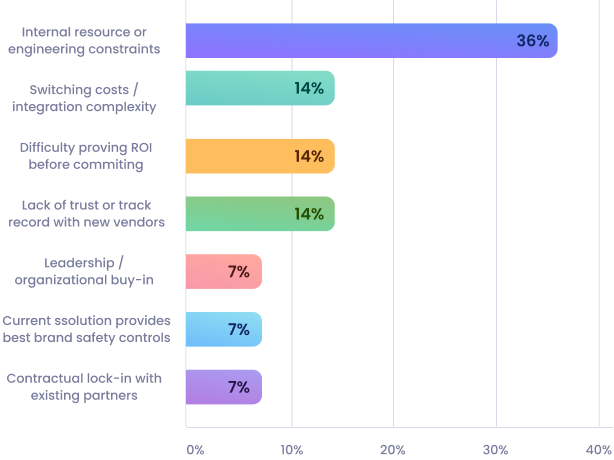
Source: EX.CO targeted CTV media owner survey, May 2026
Removing the biggest constraint
When asked about the biggest barrier to changing or upgrading their CTV stacks, respondents in our survey didn’t point to switching costs, ROI uncertainty, vendor trust, or leadership buy-in. The most common answer was internal resource and engineering constraints. Any solution that requires a dedicated yield team to operate isn’t a solution for the media owners who need it most. The bar is higher: better decisioning, without the overhead to match.
The next section puts this into practice with a real-world case study, before providing a step-by-step framework for auditing your current setup.
In practice: 33% more revenue, same headcount
PlayWorks operates one of the most distributed CTV footprints in the market: more than 400 AVOD and gaming apps, plus 24/7 linear channels, running across Roku, Samsung, LG, Comcast, Vizio, SKY, and beyond. It’s the kind of mid-market scale where the complexity is real but the yield team isn’t 20 people — exactly where the gap between available revenue and realized revenue tends to be widest.
After integrating EX.CO’s ML-driven yield engine, PlayWorks saw a 33% increase in total CTV ad revenue within 30 days. The deployment required no new app development, no operational restructuring, and no additional headcount on the monetization team. The yield engine sat above the existing infrastructure, automatically pricing each auction at the impression level, routing demand paths based on live performance signals, and sharpening its models as data accumulated.

The full PlayWorks case study, including a video interview with Aviv, is available here.
Auditing your yield gap: a four-step plan
Closing the yield gap doesn’t require a new platform decision on day one. The four steps below can be run by a revenue lead without engineering support, in roughly two weeks, using data and access most media owners already have access to.
Step 1
Signal audit
Pull a representative sample of recent bid requests — a few thousand impressions across content types and dayparts — and check what’s passing in the content object, audience signals, and slot-level data. Compare CPMs on requests with full signals against requests where signals are incomplete or missing. The delta tells you what signal cleanup is worth, and whether it’s worth prioritizing above everything else.
Step 2
Floor price review
Map your current floors against actual clearing prices over the past 90 days. Where is fill rate low, and could the floor be the cause? Where are auctions clearing well above floor? Consistent clearing at 2–3x the floor suggests revenue being left on the table with every auction. Even a one-time recalibration based on 90 days of clearing data will recover yield — though the real opportunity is making that recalibration continuous rather than periodic.
Step 3
Demand path analysis
Ask each SSP partner for bid rate, win rate, and CPM by buyer over the past quarter. Look for overlap: buyers showing up across multiple SSPs are creating auction duplication that inflates their costs without benefiting yours. Look for dark spots, too: demand paths with consistently low win rates that consume latency budget without contributing meaningful revenue. Both are candidates for consolidation.
Step 4
Infrastructure decision
Ask honestly which fixes your current ad server and yield setup can act on. Some in-stack configuration work is likely within reach. But no manual approach can support impression-level optimization, real-time demand path routing, and continuous signal monitoring simultaneously — that’s not a resource question, it’s an architectural one. Knowing which bucket each fix falls into is the difference between sustained yield improvement and a one-time cleanup that quietly degrades over the following quarter.
The audit won’t close the yield gap on its own. But it will tell you where the gap is largest, which fixes are within reach today, and where smarter infrastructure would do what manual configuration can’t.
Agentic advertising is coming — and it will reward the prepared
The programmatic ecosystem has always rewarded CTV media owners who could signal clearer, respond faster, and price smarter than their competitors. Agentic advertising raises that bar — on both sides of the auction.

Agentic advertising refers to AI-driven systems that make autonomous, real-time decisions without human intervention at the impression level. On the buy side, this means AI agents setting bids, adjusting targeting, reallocating budget, and evaluating supply quality continuously, at machine speed. On the sell side, it means yield systems that act autonomously on the media owner’s behalf: adjusting floors, routing demand paths, managing signal quality, and optimizing pod decisioning in real time, without waiting for a human to review a report and intervene.
Both sides are moving in the same direction. The question for CTV media owners is whether their infrastructure is ready to participate.
Infrastructure decision
Agentic buying systems don’t tolerate ambiguity the way human traders do. A human media buyer might overlook an incomplete content signal or a slow auction response. An AI agent evaluating CTV supply quality algorithmically will deprioritize or exclude it — automatically, at scale, without a conversation. The implications for CTV media owners are specific:
Incomplete signals will be penalized automatically.
CTV media owners who pass incomplete content objects, missing audience data, or inconsistent slot-level signals will find themselves routed around by agentic buyers before a human ever reviews the data.
Static floors will either exclude agentic buyers or underprice them.
Agentic buyers operate with precise, continuously updated valuation models. They know, at the impression level, what a given piece of CTV inventory is worth to a given campaign goal. Impression-level dynamic pricing isn’t just an optimization tactic in an agentic world; it’s the baseline requirement for competitive participation.
Supply path consolidation will accelerate.
As AI buying systems evaluate and rank CTV supply quality programmatically and continuously, spend will consolidate toward clean, direct, well-signaled supply paths faster than any human-led SPO process could achieve. CTV media owners with optimized stacks will capture more agentic spend. Those with noisy, over-intermediated infrastructure will be filtered out algorithmically.
What agentic yield management means for CTV media owners
The more significant opportunity is on the sell side. The shift from reactive yield management (reviewing dashboards, adjusting floors quarterly, checking SSP performance monthly) to proactive, autonomous optimization is the CTV media owner’s version of what agentic advertising represents for buyers. Rather than responding to what already happened, agentic yield systems anticipate market conditions, adjust supply strategy in response to live buyer behavior, and make decisions across the entire CTV auction stack in real time.
The infrastructure requirements for competing in an agentic buying environment and for deploying agentic yield management are the same: clean signals, impression-level decisioning, and real-time demand path intelligence. CTV media owners who build toward that foundation now will be positioned to deploy more sophisticated automation as it matures — rather than scrambling to catch up when agentic systems are already the norm on both sides of the auction.
Conclusion: Why the timing matters now
Two trends are moving in parallel, and neither favors waiting. On the buy side, supply path optimization is consolidating spend toward media owners with clean, efficient supply chains — and the rise of agentic advertising will accelerate that consolidation further.
On the sell side, ML-driven yield infrastructure is becoming accessible to mid-tier media owners in ways it wasn’t 12 months ago— bringing impression-level pricing, demand path intelligence, and signal monitoring to operations that couldn’t previously justify the investment.
Media owners who move quickly to close their yield gap now will capture a disproportionate share of the spend buyers are actively consolidating. The ones who don’t will keep losing buyer share, even if their content and audience are stronger than the competition.
The yield gap described in this guide — signal degradation, static floors, display-era auction architecture — isn’t a demand problem. It’s an infrastructure problem. And infrastructure problems are solvable, without rebuilding from scratch.
EX.CO’s ML-driven yield engine helps CTV media owners close that gap: optimizing floors at the impression level, routing demand paths based on live performance signals, and monitoring signal quality in real time — without requiring new infrastructure or additional headcount.
The media owners who win the next era of CTV won’t be the ones with the most demand. They’ll be the ones who were smartest about the demand they already had.
Ready to close your yield gap?
Speak with one of our experts to learn how the EX.CO platform
can enhance your video investment strategy.